


Sunair R-8400 HF RECEIVER, WIDEBAND
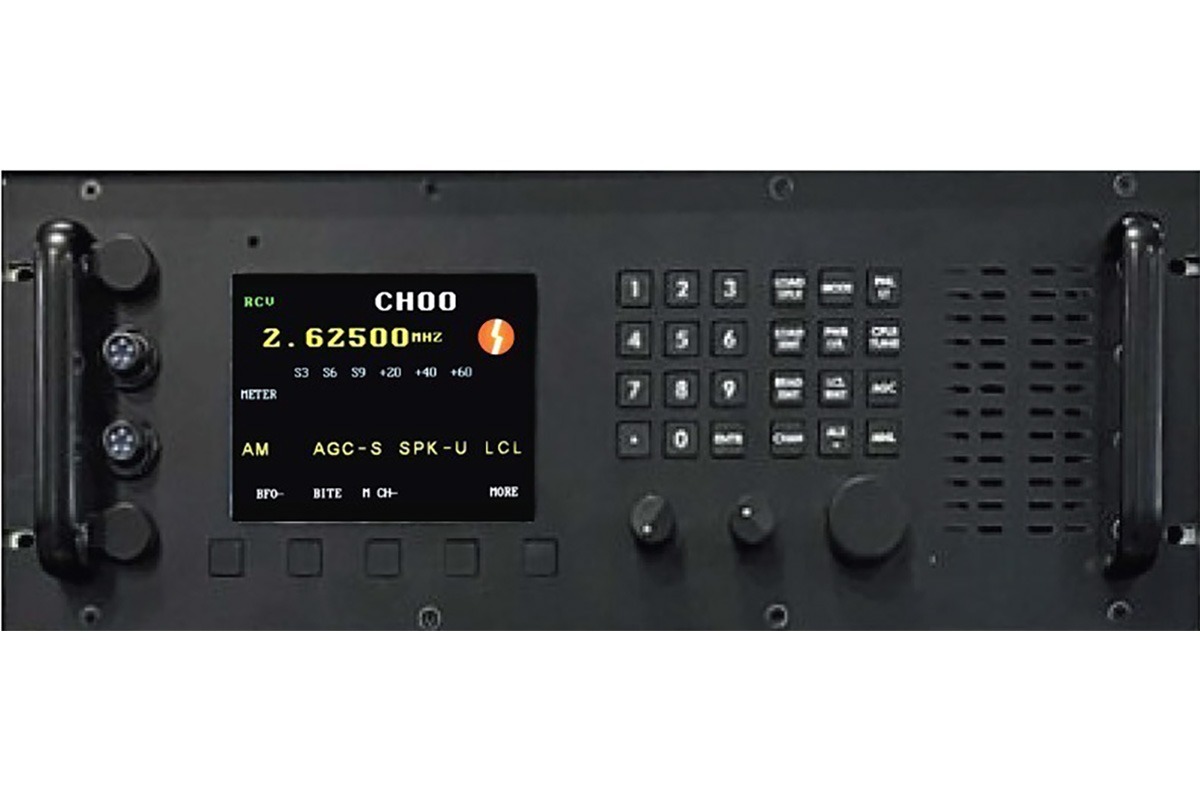
The Sunair R-8400 HF Receiver, Wideband is a solution for communications applications requiring rugged, reliable, and flexible equipment. It has been designed to be paired with our T-8400 Transmitter to accommodate split-site operation or to be used for standalone, single-site receiver operation. This next-generation receiver is equipped with a larger 7-inch TFT display, which is now touchscreen. It operates continuously (100%
duty cycle) in AME, NB-FM, USB, LSB, ISB, CW, Data, or MELPebased Digital Voice modes. The Sunair R-8400 HF Receiver, Wideband uses software-defined digital signal processing (DSP) technology, which supports the latest developments in high-speed waveform processing. This technology enhances the functionality of the CPU as well as the Synthesizer, Digital Audio, and Digital IF stages. The audio interface supports analog or VoIP connections, while the CPU allows for remote control and programming via Ethernet or serial port.
When operating in split-site mode in combination with the Sunair T-8400 transmitter, the Sunair R-8400 HF Receiver, Wideband offers an optional internal solution (hardware module and licenses) for data link operation (receive only) in compliance with MIL-STD-188-203-1A and STANAG 5511/5522 (TADIL-A/Link 11 and NILE/Link 22). In this setting, it also supports Automatic Link Establishment (ALE) as an external option in accordance with MIL-STD-188-141 A/B/C, FS1045A, and S4538 as well as STANAG 4444.
The radio’s advanced built-in-test (BITE) capability provides feedback to the lowest replaceable unit (LRU) level by means of test result messages in English on the display as well as LED indications.
The Sunair R-8400 HF Receiver, Wideband can operate from both ac and dc voltage sources with automatic changeover if one of them fails. Its internal power supply provides energy to the internal modules as well as to external accessories.
The Sunair R-8400 HF Receiver’s intuitive modular design allows for ease of maintenance, expansion, and upgrade throughout the equipment life cycle at minimal expense. Its construction minimizes undesirable RFI and EMC effects by using multiple layers of shielding as well as filtering and protection on the individual control lines.
Thousands of these radios are in daily service as integral components of critical strategic communications solutions worldwide.
• Analog or VoIP audio interface
• VoIP ATM ED-137B/C (EUROCAE ED-137C)
• Software-Defined Next Generation HF SSB/ISB Transmitter
• High efficiency solid state design Full power into load VSWR up to 2:1
• Comprehensive BITE to LRM (Lowest Removable Module) Full function remote control via serial or Ethernet
• Remote control via RS-232/422/485 and Ethernet
• Tactical Data Link – MIL-STD-188-203-1A TADIL A and Link 11/22 (requires external modems and controllers) HF Data – MIL-STD-188-110A/B
• Internal 115 / 230 Vac ±15 %; 50 / 60 Hz; single phase power supply
• Data Link – MIL-STD-188-203-1A TADIL A and Link 11/22 (factory installed option)
• HF Data – MIL-STD-188-110 A/B/C and STANAG
• ALE – 2G MIL-STD-188-141 A/B/C and 3G STANAG 4538
• Secure Digital Voice (MELPe S4591)
CERTIFICATIONS AND STANDARDS
- Data Link – MIL-STD-188-203-1A TADIL A and Link 11/2 (factory installed option)
- Type 1 encryption such as ANDVT, KY-99, KG-84(), and KG-40 as well as commercial privacy devices or optional internal MELPe digital voice F/W with DES 56, AES 128 & AES 256 encryption functions
- HF Data – MIL-STD-188-110 A/B/C and STANAG
- ALE – 2G MIL-STD-188-141 A/B/C and 3G STANAG 4538
- Secure Digital Voice (MELPe S4591)
- MIL-STD-188-203-1A and STANAG 5511/5522 (TADIL-A/Link 11 and NILE/Link 22) for data link operation
- MILSTD-188-110 A/B/C and STANAG HF modem waveforms
- MIL-STD-188-141 A and FS1045A
- MIL-STD-188-141 B and STANAG 4538
- MIL-STD 810F, Method 516.5, Procedure 1
- MIL-STD 810F, Method 514.5 & MIL-STD-167-1
- EN 300 373-2 v1.2.1
- EN 301 843-5 v1.1.1
- EN 60950
- Notified Body 1177
- STANAG 5066 controller

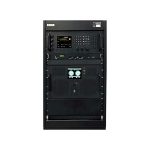
Wideband HF receiver
An HF wideband receiver captures a large chunk of the High Frequency spectrum (typically 9 kHz to 32 MHz) simultaneously, using high-speed processing like FFTs and Digital DownConverters (DDCs), allowing for rapid spectrum scanning, monitoring multiple signals, and detailed analysis, often with options for I/Q output and advanced DSP for applications in intelligence, defense, and spectrum management, differing from traditional narrowband receivers that tune to one frequency at a time.
- Broad Frequency Coverage: Usually from Very Low Frequency (VLF) up to 30 or 32 MHz, covering the entire HF band.
- High-Speed Processing: Utilizes large Fast Fourier Transforms (FFTs) for real-time spectrum display and analysis.
- Digital Downconversion (DDC): Creates multiple virtual narrowband receivers (DDC channels) from the wideband signal, allowing simultaneous monitoring.
- I/Q Data Output: Provides raw In-phase/Quadrature (I/Q) data for external analysis on a computer.
- Dynamic Range & Sensitivity: Designed with low noise figures and high dynamic range for clear reception.
- Pre-selection Filters: Internal filters optimize signal integrity and reduce interference.
- Signal Intelligence (SIGINT): Monitoring and classifying signals.
- Spectrum Management: Identifying interference and analyzing spectrum usage.
- Broadcasting: Monitoring international shortwave broadcasts.
- Research & Defense: Applications requiring wideband situational awareness.