


SUNAIR ARGUS 9000E MCC SOFTWARE
The Sunair ARGUS 9000E MCC software is the ideal tool to remotely and simultaneously monitor, configure, and control up to eighteen (18) Sunair 8000 Series radios like those used in Ground to Air, Ship to Shore, and similar applications where operators work from specialized consoles.
Remote administrators and technicians can efficiently maintain and troubleshoot any model of the Sunair 8000 Series radios, whether Military RT-8500WB HF Transceiver Wideband, T-8400 HF Transmitter, Military T-10000 HP 10kW HF Transmitter Wideband, Military 8220WB 1 kW HF Transmitter Wideband, Military R-8400 HF Receiver Wideband.
If one or more of the radios are part of a high power transmitter, such as the 500-W, 1-kW, 5-kW, or 10-kW models, the Argus software adapts accordingly to include the corresponding
parameters and controls.
The Sunair ARGUS 9000E MCC software provides a graphical representation of each monitored or controlled radio with the corresponding identification information,
including the individual IP addresses, as well as visual fault and key status indicators.
The Radio Control screen above enables remote administrators to instantly modify the current operational parameters, whether active channel, operating frequency,
modulation mode, AGC timers, or output power for testing and troubleshooting purposes.
The remote administrators can also select any of the available 255 channels to change its configuration and save the changes for fast backup or cloning purposes.
Conversely, remote administrators can easily upload a saved channel configuration onto a radio for a fast return to service or for cloning multiple radios.
ALE 2G and 3G controls are available on the Radio Control screen to start or stop any or both ALE modes as well as to perform basic operations.
When using the Monitor screen, remote administrators can obtain a snapshot of the current operational parameters of the monitored radio without interrupting any ongoing radio contact. At the same
time, the status indicators provide a comprehensive picture of the operational condition of the monitored radio.
The Sunair ARGUS 9000E MCC software saves the parameter and indicator information of each monitored radio at preset intervals, or when triggered by specific events, for later retrieval.
Remote technicians can also take advantage of the information provided by the Monitor screen to reduce troubleshooting time.


- Remotely and simultaneously monitor, configure, and control
- It is possible to select any one out of the up to 18 radios from the Main
screen to either monitor, configure or control the selected radio.
CERTIFICATIONS AND STANDARDS
- Data Link – MIL-STD-188-203-1A TADIL A and Link 11/2 (factory installed option)
- Type 1 encryption such as ANDVT, KY-99, KG-84(), and KG-40 as well as commercial privacy devices or optional internal MELPe digital voice F/W with DES 56, AES 128 & AES 256 encryption functions
- HF Data – MIL-STD-188-110 A/B/C and STANAG
- ALE – 2G MIL-STD-188-141 A/B/C and 3G STANAG 4538
- Secure Digital Voice (MELPe S4591)
- MIL-STD-188-203-1A and STANAG 5511/5522 (TADIL-A/Link 11 and NILE/Link 22) for data link operation
- MILSTD-188-110 A/B/C and STANAG HF modem waveforms
- MIL-STD-188-141 A and FS1045A
- MIL-STD-188-141 B and STANAG 4538
- MIL-STD 810F, Method 516.5, Procedure 1
- MIL-STD 810F, Method 514.5 & MIL-STD-167-1
- EN 300 373-2 v1.2.1
- EN 301 843-5 v1.1.1
- EN 60950
- Notified Body 1177
- STANAG 5066 controller
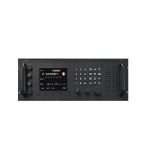
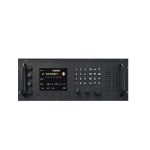

Wideband 10kW HF transmitters
Wideband 10kW HF transmitters are high-power, solid-state systems primarily used for long-range military, government, and aviation communications and broadcasting. These systems utilize Software-Defined Radio (SDR) and modular amplifier architecture to enable high-speed data transmission and frequency agility.
Key Components:
- Software-Defined Exciter: The digital heart of the transmitter that synthesizes the carrier and applies modulation.
- Modular Power Amplifiers (PA): Instead of a single large unit, 10kW systems typically combine multiple smaller solid-state modules (e.g., eight 1.25kW or twenty-four 500W modules). These often use rugged MOSFET or LDMOS technology for high efficiency and linear performance.
- High Power Combiner: A critical passive component that merges the outputs of individual PA modules into a single 10kW signal while maintaining phase stability and low loss.
- High Power Amplifier Controller (HPAC): A central management unit that monitors system balance, adjusts output levels, and manages safety shutdowns.
- Power Supply Unit (PSU): Often configured with Soft Start circuits to prevent failure from peak voltage at startup. PSUs are typically 3-phase (e.g., 380 VAC) and can consume up to 35-40 kVA for a 10kW output.
- Cooling Systems:
- Forced Air: Standard in many units, using fans integrated into each PA module.
- Liquid Cooling: It is not recommended due to major security issues.
- Graceful Degradation (Hot Swap): The modular design allows the transmitter to stay on-air at reduced power even if one or two modules fail. Many systems support Hot Swapping, enabling module replacement without shutting down the entire transmitter.
- Wideband Capability & ALE: Optimized for frequency-agile scenarios including Automatic Link Establishment (ALE) 2G and 3G (MIL-STD-188-141B).
- Advanced Digital Processing: Includes Digital Pre-Distortion (DPD) to improve linearity and reduce intermodulation distortion (IMD), and digital I/Q modulation to achieve low phase noise.
- Built-in Test Equipment (BITE): Real-time monitoring that reports status down to the Lowest Replaceable Unit (LRU), often visible via front-panel displays or remote interfaces.
- Remote Management: Comprehensive control via Ethernet (TCP/IP), RS-232, or RS-422, allowing operators to change frequencies, modes, and power levels from a remote operations room.
- Protection Circuits: Automated safeguards against high VSWR (Voltage Standing Wave Ratio), over-temperature, over-current, and smoke detection