


Sunair RCU-8310 HF REMOTE CONTROL UNIT
The Sunair RCU-8310 Remote Control Unit is a full-function remote control unit, now capable of operating up to eight (8) transceivers, transmitters, or receivers from the 8400 series. The next-generation Sunair RCU-8310 HF Remote Control Unit is equipped with a larger 7-inch TFT display, which is now touchscreen, along with keyboard entry. Its front panel is physically identical to the front panel of the unit it controls. This ensures operational simplicity. The Sunair RCU-8310 Remote Control Unit offers a full set of operating modes, including AME, NB-FM, USB, CW, Data, as well as remote control of
Automatic Link Establishment (ALE) functions when the RT-8400 is equipped with the internal ALE option. These capabilities match the operating modes available on the radio itself. The Sunair RCU-8310 Remote Control Unit also allows remote operation of Sunair peripheral equipment including the F-9810 PreSelector/Post-Selector, the LPA-8210/8220 Power Amplifiers, and the CU-9125/CU-9150 Antenna Couplers.
It is possible to connect the Sunair RCU-8310 HF Remote Control Unit to the remote radio using RS-232/RS-422 for short distances, Ethernet for longer distances, or leased lines (requires the optional internal FSK modem).
Advanced built-in-test (BITE) capability provides feedback to the lowest replaceable unit (LRU) level for both the local Sunair RCU-8310 Remote Control Unit as well as the companion 8400 series radio. The remote control’s intuitive modular design allows for ease of maintenance and upgrade throughout the equipment life cycle at minimal expense.
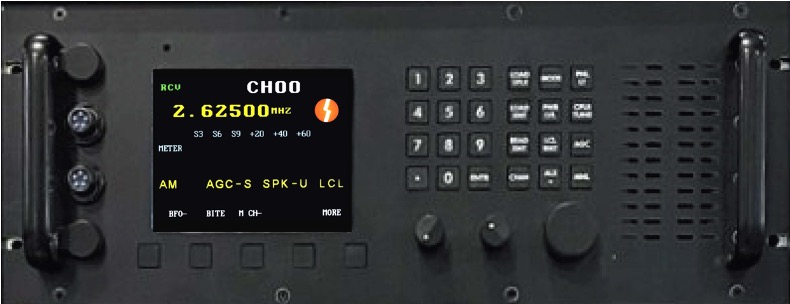
• Analog or VoIP audio interface
• VoIP ATM ED-137B/C
• Microphone and 600Ω balanced at -20 to +20 dBm
• 5 W Into Internal Speaker, < 1% THD
• Remote control via RS-232/422/485 and Ethernet
• Comprehensive BITE to LRM
• Internal 115/230 Vac power supply
• Data Link – MIL-STD-188-203-1A TADIL A and Link 11/22
(factory installed option)
• HF Data – MIL-STD-188-110 A/B/C and STANAG
• ALE – 2G MIL-STD-188-141 A/B/C and 3G STANAG 4538
• Secure Digital Voice (MELPe S4591)
CERTIFICATIONS AND STANDARDS
- Data Link – MIL-STD-188-203-1A TADIL A and Link 11/2 (factory installed option)
- Type 1 encryption such as ANDVT, KY-99, KG-84(), and KG-40 as well as commercial privacy devices or optional internal MELPe digital voice F/W with DES 56, AES 128 & AES 256 encryption functions
- HF Data – MIL-STD-188-110 A/B/C and STANAG
- ALE – 2G MIL-STD-188-141 A/B/C and 3G STANAG 4538
- Secure Digital Voice (MELPe S4591)
- MIL-STD-188-203-1A and STANAG 5511/5522 (TADIL-A/Link 11 and NILE/Link 22) for data link operation
- MILSTD-188-110 A/B/C and STANAG HF modem waveforms
- MIL-STD-188-141 A and FS1045A
- MIL-STD-188-141 B and STANAG 4538
- MIL-STD 810F, Method 516.5, Procedure 1
- MIL-STD 810F, Method 514.5 & MIL-STD-167-1
- EN 300 373-2 v1.2.1
- EN 301 843-5 v1.1.1
- EN 60950
- Notified Body 1177
- STANAG 5066 controller
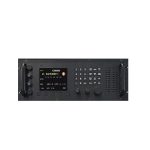
HF (High-Frequency) Remote Control Unit
HF (High-Frequency) Remote Control Units have evolved from simple wired extensions to sophisticated, network-integrated interfaces that allow for the complete operation of a radio station—often located miles away—via LAN, Wi-Fi, or cellular data.
HF transmitter remote control units are available as both dedicated hardware consoles (like the Sunair RCU-9310D) and software-based computer control systems, primarily for military, commercial, and amateur radio (ham) applications. These units offer control over frequency selection, power output, operating modes, and system monitoring.
- Direct LAN Connectivity: High-end 2026 radios feature built-in servers that connect directly to a home network or the internet. The operator simply plugs in a LAN cable to make any tabletop their radio “shack”.
- Cloud-Based Control: Services like “Remote Ham Radio” provide web-based consoles accessible via browsers (Chrome, Safari), allowing users to operate high-power stations globally without owning any hardware locally.
- Remote Power Management: Modern setups include units to remotely monitor “vital signs” of the station, such as power consumption, antenna tower status, and environmental conditions at the remote site.
- Buffer Management: Essential for 2026 digital modes, modern units like the RC-7760 adjust for network jitter to ensure precise CW (Morse code) keying even over unstable internet connections.
- Multi-Head Registration: New systems allow up to five control heads to be registered to a single RF deck, though only one can take control at a time.
- Encryption Support: Tactical remote units now standardly include AES-256 encryption for voice, data, and frequency-hopping commands.
- Control & Monitoring: Duplicates buttons, displays, and controls, allowing frequency changes, mode selection, power adjustment, and monitoring of system health (BITE).
- Connectivity: Uses Ethernet, serial (RS-232), or fiber optics for high-bandwidth, low-EMI connections to the main transmitter unit.
- Software-Defined: Modern systems often run on DSPs and software, enabling advanced data, email, fax, and high-speed data features (like ALE).
- Channel Management: Stores presets for quick access to programmed channels and frequencies (e.g., 99 user-defined, ITU channels).
- Professional/Military: High-power units (RCU-9310D) for secure, High-power units (RCU-8310) for secure, mission-critical C3 (Command, Control, Communications) systems in defense, aviation (ATC), and government.
- Amateur (Ham) Radio: Solutions like Palstar HF-AUTO-R, R&S®M3SR Series4100 software defined radios for remote operation of base stations, using dedicated hardware or even PCs (TeamViewer, AnyDesk) and Raspberry Pis for web-based control.
- Transmitter Cabinet: Houses Power Amplifier (PA), matching circuits, and power supplies.
- Exciter Unit: Generates the signal.
- Antenna Coupler: Solid-state tuning for reliable antenna matching.
- Remote Control Unit (RCU): The physical interface for the operator.