


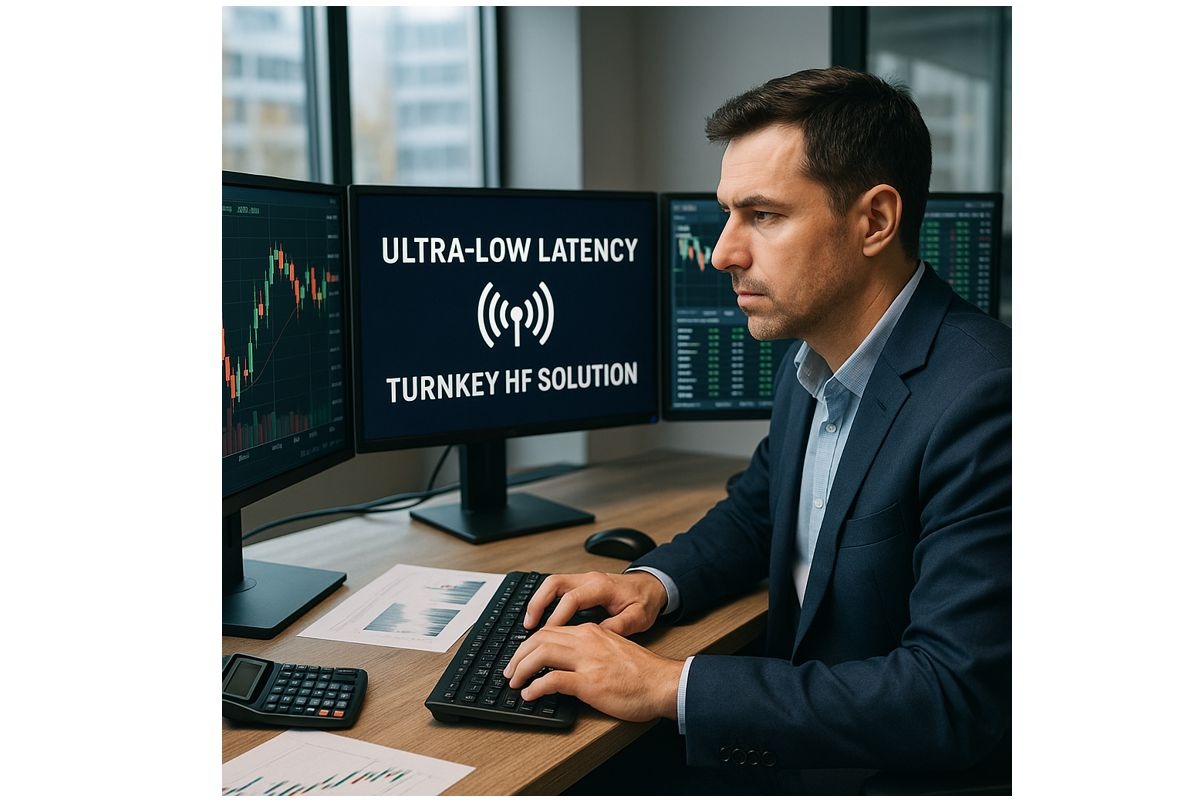
Key aspects of HF ultra-low latency:
- Minimizing Delay:
The core goal is to reduce the time between initiating a transaction and its completion to the absolute minimum.
- Competitive Advantage:
In HF trading, where milliseconds matter, ultra-low latency provides a significant edge over competitors.
- Real-time Processing:
Ultra-low latency is essential for applications requiring real-time data processing and immediate response, such as financial markets, autonomous vehicles, and industrial automation.
- Optimized Configurations:
Achieving ultra-low latency involves optimizing network interfaces, storage solutions, CPUs/GPUs, and data paths.
- Examples:
High-frequency trading, autonomous vehicles, industrial automation, and remote surgery all benefit from ultra-low latency.
- High-speed network interfaces:
Utilizing technologies like Microwave Millimeter Wave and FSO (Free Space Optics) for wireless communication can offer lower latency than traditional fiber optic networks, according to CableFree.
Field-Programmable Gate Arrays (FPGAs), such as the Alveo UL3524, can be used to accelerate specific trading algorithms and data processing tasks, significantly reducing latency.
- High-frequency trading servers:
Specialized servers like the CIARA ORION HF series are designed for ultra-low latency environments, offering features like overclocked processors and high-speed PCIe slots.
In gaming, NVIDIA Reflex and Ultra Low Latency Mode can reduce render queue delays, improving responsiveness.
- Software optimizations:
Technologies like Disruptors, Aeron, and Chronicle Software’s solutions are used in Java for low-latency applications, according to a Reddit thread.
- Wireless solutions:Wireless technologies like the CVW Thunder 4 Channels Video Kit offer ultra-low latency for video transmission in various applications, according to Innport.
- High-Frequency Trading (HFT): ULL HF is used to execute trades between distant financial hubs (e.g., London to New York or Chicago). Because HF radio waves travel through the air at nearly the speed of light—approximately 50% faster than light traveling through glass fiber—traders can gain a millisecond-level advantage that is worth millions annually.
- Defense and Strategic Communications: ULL solutions are integrated into tactical HF transmitters and command systems (C3) for secure, minimal-delay data transmission in military environments.
- Remote Mission-Critical Operations: Used in strategic environments such as shipboard or vehicular installations where real-time, long-range communication is required without the lag of satellite or the constraints of wired infrastructure.
- Skywave Propagation: Using the ionosphere to bounce HF signals over the horizon, creating the shortest possible path between two points on Earth.
- FPGA-Based Hardware: Trading platforms and transmitters use Field-Programmable Gate Arrays (FPGAs) like the AMD Alveo UL3422 to process data in nanoseconds, bypassing the slower processing times of traditional CPUs.
- Microwave & Millimeter Wave Bridges: Often used in tandem with HF for “last-mile” or medium-range ULL links to connect data centers to the HF radio towers.
- Optimized Networking Protocols: Solutions like BSO RF Ultra provide dedicated Layer 1 connectivity that avoids the “jitter” and delays found in standard internet framing.
- Speed Advantage: Electromagnetic signals in the air travel at ~300,000 km/s, whereas signals in fiber travel at ~200,000 km/s due to the refractive index of glass.
- Latency Range: ULL HF trading aims for sub-millisecond end-to-end delays across oceans, while local system processing (server-to-wire) target nanoseconds.
- High-Frequency Trading (HFT): This is the leading commercial application. Trading firms use HF “Skywave” links to transmit market data and orders between global financial hubs (e.g., London and New York). Because radio waves travel ~50% faster through the air than light through a glass fiber-optic cable, HF can reduce intercontinental round-trip times by dozens of milliseconds.
- Defense & Mission-Critical Communications: Modern military and government systems utilize ULL HF for secure, long-range command and control (C3) without the latency of satellite links or the vulnerability of undersea cables.
- Emergency Response & Remote Operations: Used in environments where fiber is absent or too slow, such as maritime navigation or disaster zones, to provide immediate data links for autonomous systems and real-time monitoring.
- Speed Advantage: Electromagnetic signals in the air move at nearly the speed of light (c≈300,000c is approximately equal to 300 comma 000
𝑐≈300,000
km/s), while fiber optics are limited to
∼200,000tilde 200 comma 000∼200,000
km/s due to the refractive index of glass.
- Target Latency: Commercial ULL HF links aim for microsecond to nanosecond internal processing delays, while transoceanic signal propagation is measured in milliseconds.
- Hardware Integration: Solutions frequently employ FPGA-based trading cards like the AMD Alveo UL3422, which allows for nanosecond-level trade execution on the server side.
- Advanced Routing: Providers like BSO RF Ultra utilize optimized geodesic routing—the shortest possible physical path—to shave every available microsecond off critical transmission routes.